

There is a quiet revolution happening on footpaths and neighbourhood streets, and it does not involve expensive equipment, gym memberships, or complicated plans. It is walking. The most ancient, accessible, and underestimated form of movement that humans have ever known.
I think about a client of mine — a 52-year-old man named Rajesh, a banker who spent 10 hours a day at a desk and came to us convinced he needed an intense exercise programme to improve his blood pressure, manage his pre-diabetic blood sugar, and lose the extra 12 kilograms he had gained over the pandemic. What we started him on was a 20-minute walk every morning before work. Six months later, his blood pressure was in the normal range, his HbA1c had dropped, and he had lost 7 kilograms — without a single visit to the gym.
Walking is not a consolation prize for people who cannot exercise. It is a genuinely powerful health intervention, backed by decades of research. Here is what the science says.
Walking is one of the most researched and effective health habits available. Discover what it does for your heart, blood sugar, mental health, bones, and weight — and how to start.
What Happens Inside Your Body When You Walk?
Even a moderate-paced walk triggers a cascade of biological changes:
- Heart rate elevates slightly, increasing blood flow and cardiovascular conditioning over time
- Muscles activate — glutes, hamstrings, calves, and core all engage during walking
- Insulin sensitivity improves — muscles use glucose during movement, which helps regulate blood sugar
- Endorphins and serotonin rise — even a short walk can shift your mood within minutes
- Cortisol begins to drop — rhythmic movement is genuinely calming to the nervous system
- Digestion improves — walking after meals stimulates gut motility
The Cardiovascular Benefits
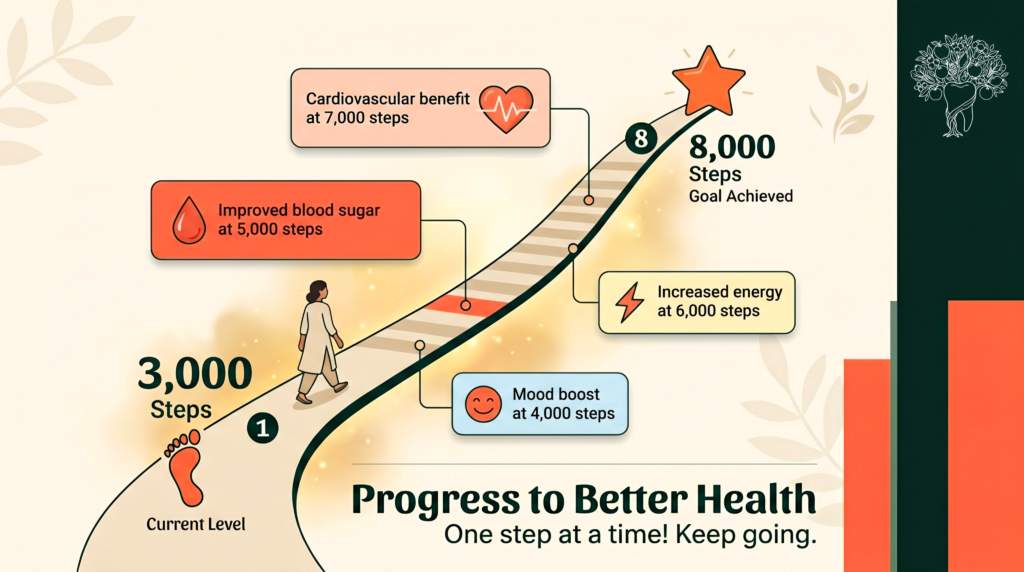
Walking is classified as moderate-intensity aerobic activity, and regular moderate-intensity aerobic activity is the single most impactful lifestyle factor for cardiovascular health, according to research published in journals like the British Journal of Sports Medicine.
Studies show that regular walkers have significantly lower rates of heart disease, stroke, and hypertension compared to sedentary individuals. Even those who take up walking later in life — in their 50s, 60s, or 70s — see measurable improvements in cardiovascular risk markers.
One widely cited study found that walking at least 8,000 steps a day was associated with a 51% lower risk of all-cause mortality compared to taking fewer than 4,000 steps. The dose-response curve is reassuring: more is better, but even modest increases matter.
A landmark study following contestants from the television show The Biggest Loser found that years after the show, participants had a metabolic rate significantly lower than expected for their size. Some were burning up to 500 fewer calories per day than predicted. This slowing is not a side effect — it is your body doing exactly what it is designed to do when food becomes scarce.
Walking and Mental Health
The research on walking and mental health is striking. Multiple randomised controlled trials have shown that regular walking reduces symptoms of depression and anxiety — in some cases, comparably to low-dose antidepressant medication, particularly for mild to moderate depression.
Walking in natural environments (green spaces, parks, along water) produces even greater mental health benefits — a phenomenon that researchers call “green exercise.” The combination of movement, natural light, and contact with nature appears to lower the body’s stress response particularly effectively.
For people managing workplace stress, chronic anxiety, or low-grade burnout, a consistent walking practice is one of the most evidence-supported non-pharmacological interventions available.
Blood Sugar, Insulin Resistance, and Walking After Meals
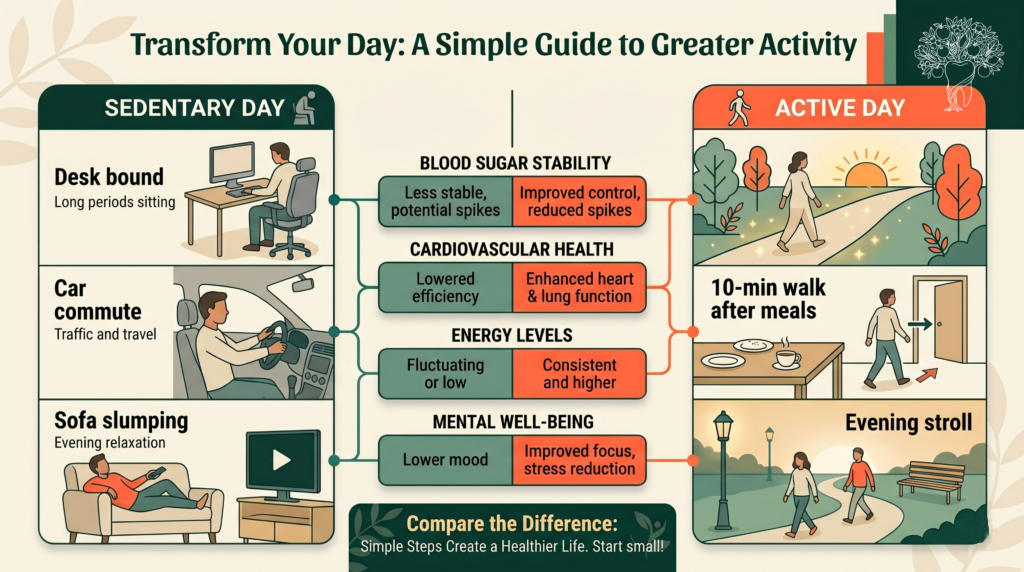
One of the most practical and powerful uses of walking is a short 10–15 minute walk after meals. Research consistently shows that post-meal walking significantly blunts the blood sugar spike that follows carbohydrate intake.
For people with pre-diabetes, type 2 diabetes, or insulin resistance, this is genuinely significant. The muscle contractions during walking act like a sponge, absorbing glucose from the bloodstream independently of insulin. Even a gentle, slow walk activates this mechanism.
Rajesh, our banker client, started with a 10-minute walk after lunch. His afternoon energy crashes — which he had attributed to “just getting older” — disappeared within two weeks. His nutritionist later explained that his post-lunch blood sugar spikes had been sapping his afternoon energy, and the walk was directly addressing that.
Weight Management and Body Composition
Walking burns calories — that part is well understood. A 70-kilogram person walking at a moderate pace burns roughly 250–300 calories per hour. But the less obvious benefit is what happens beyond the walk itself.
Regular walkers tend to maintain more muscle mass as they age compared to sedentary people, in part because walking is a weight-bearing activity that places gentle mechanical load on the bones and muscles of the lower body. This is particularly relevant for women over 40 as a complement to dietary protein for preserving lean mass.
Walking also reduces visceral fat — the fat stored around the organs — which is the most metabolically harmful type. Studies in people who walked consistently for 12 weeks showed measurable reductions in waist circumference even without significant changes in diet.
Bone Health and Joint Longevity
One of the greatest misconceptions about joint health is that exercise wears joints down. For walking, the opposite is true. The gentle, repetitive loading of walking stimulates the cartilage of the knee and hip joints to absorb nutrients and stay hydrated — a process that does not happen effectively at rest.
For bone density, walking is a weight-bearing activity, which means it stimulates bone remodelling and can slow the progression of osteoporosis. This is especially important for post-menopausal women, for whom bone density loss accelerates significantly. A 30-minute daily walk has been shown in multiple studies to reduce hip fracture risk in older women.
How to Build a Walking Habit That Lasts
The biggest barrier to walking is not time — it is habit formation. Here is what actually works:
- Anchor it to something existing — walk after a meal, during a phone call, or before your morning tea
- Start embarrassingly small — 10 minutes is enough to begin. Trying to go from zero to 10,000 steps on day one is how most people quit
- Make it social or sensory — a walking partner, a podcast, or a favourite playlist dramatically improves adherence
- Track it loosely — a basic pedometer or phone step counter adds gentle accountability without pressure
- Walk with intention — speed up your pace slightly to where conversation requires a bit of effort — this is the “moderate intensity” sweet spot
How Much Is Enough?
The widely known goal of 10,000 steps per day was originally a marketing figure from a Japanese pedometer company, not a medical recommendation. Current research suggests 7,000–8,000 steps per day is where most health benefits are realised — and meaningful benefits begin appearing at as few as 4,000–5,000 steps.
The World Health Organisation recommends at least 150–300 minutes of moderate-intensity aerobic activity per week for adults. A brisk 30-minute walk, five days a week, meets this target entirely.
The Final Word
Walking does not need a hashtag or a motivational quote. It is quietly, consistently one of the most impactful things you can do for your health — cardiovascular, metabolic, musculoskeletal, and mental. It is free, it is accessible, and it scales with wherever you are in your fitness journey.
Start with ten minutes. Go a little further tomorrow. The path, quite literally, takes care of itself.
drbansi@tastifit.com
Nutritionist & Dentist
- April 19, 2026
- 9:24 am
- TastiFit
- Dr. Bansi Parikh