
I remember a family that came to our clinic when their youngest child, Aarav, was five years old. His mother had noticed a dark spot on one of his back teeth and was not particularly worried. “It’s a milk tooth,” she said. “It’ll fall out anyway.” What we found when we examined Aarav was a cavity that had progressed well into the dentine, causing the beginning of an infection. Without treatment, that infection would have spread — potentially affecting the permanent tooth forming beneath it, and causing Aarav significant pain in the months ahead.
This assumption — that baby teeth do not matter because they are temporary — is one of the most common, and most costly, misconceptions in pediatric dental health. The truth is that milk teeth, formally called primary teeth, serve a set of critical functions that directly shape your child’s lifelong oral health.
Baby teeth aren't just temporary — they guide jaw development, speech, and permanent tooth alignment. Discover why paediatric dental care starts at age one and what to watch for.
The Role of Primary Teeth: More Than Placeholders
Baby teeth are not just practice runs for adult teeth. They are functional, living structures that serve specific, irreplaceable purposes in a child’s development.
Chewing and Nutrition
Children need to eat, and they need their teeth to do it properly. Decayed or painful teeth cause children to avoid chewing on one side, reject nutritious foods with texture, and gravitate toward soft, often sugary alternatives. This dietary limitation during the critical growth years between ages 2 and 10 can have lasting nutritional consequences.
Speech Development
Teeth are directly involved in how children form sounds. The letters ‘th’, ‘f’, ‘v’, ‘s’, ‘z’, and ‘l’ all depend on the tongue’s relationship to the teeth. Early tooth loss, particularly of the front teeth, is a known risk factor for speech delays and articulation difficulties in children. In some cases, children need speech therapy to correct patterns that developed as a result of missing teeth during language acquisition.
Space Maintenance for Permanent Teeth
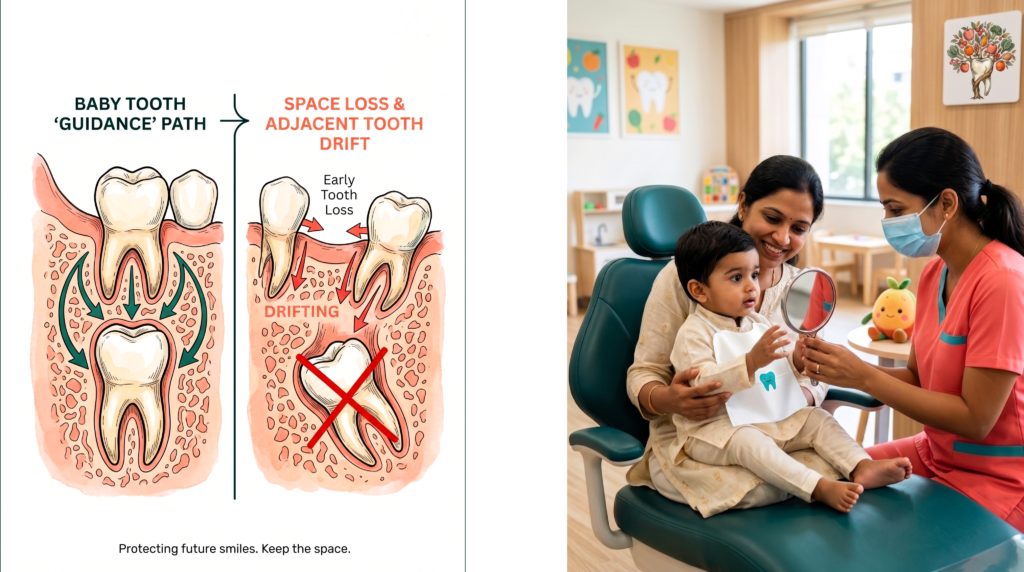
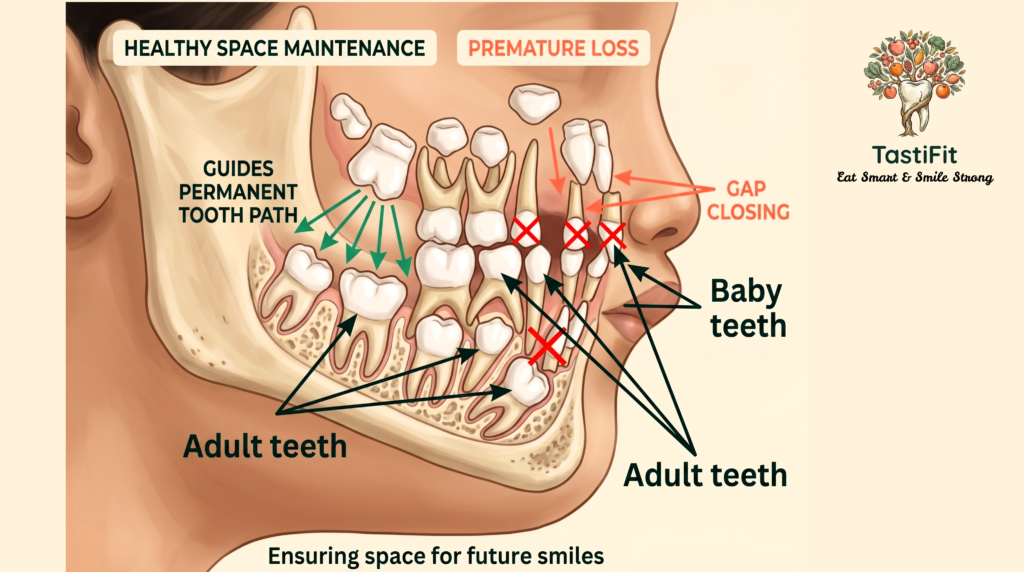
This is perhaps the most underappreciated function of baby teeth. Each milk tooth acts as a natural space maintainer, holding the gap open for the permanent tooth forming below it. When a primary tooth is lost prematurely — through decay, trauma, or early extraction without a space maintainer — adjacent teeth drift into the gap. This can cause the permanent tooth to erupt crooked, impacted, or in the wrong position entirely. The resulting misalignment often requires years of orthodontic treatment that might have been preventable.
Jaw and Facial Development
The jawbone grows in response to the forces placed upon it by the teeth. Healthy teeth ensure balanced jaw growth and proper facial development. Chronic pain or premature tooth loss disrupts these forces, potentially affecting the shape and symmetry of the child’s jaw as it grows.
Understanding Childhood Tooth Decay. It Is More Common Than You Think
Dental caries (tooth decay) is the single most common chronic disease in children globally, according to the World Health Organisation. In India, studies suggest that more than 50% of children under the age of six have some degree of tooth decay — often undetected by parents because it does not always cause obvious pain in the early stages.
How Decay Progresses in Children
What makes childhood decay particularly aggressive is the structure of primary teeth. Baby teeth have thinner enamel and dentine compared to adult teeth, which means decay progresses faster. A cavity that might take years to become serious in an adult can reach the nerve of a baby tooth within months.
The pattern of decay also differs. Early Childhood Caries (ECC) — sometimes called bottle rot or nursing caries — is a specific form of decay linked to prolonged bottle use, frequent sugary drinks, and putting babies to sleep with a bottle of milk or juice. It can devastate the front teeth rapidly, leaving children in pain and with significant aesthetic and functional challenges.
Signs Parents Should Not Ignore
- White spots on the teeth — this is the earliest visible sign of demineralisation, before a cavity actually forms. It is reversible with fluoride and good hygiene at this stage.
- Brown or black spots — these indicate active or advanced decay and require professional treatment
- Sensitivity to sweets, hot, or cold — suggests the decay has reached the dentine
- Swelling around a tooth — indicates a possible infection or abscess, which requires urgent attention
- Child refusing to chew on one side — often a sign of dental pain that the child cannot yet verbalise clearly
When Should Children First Visit a Dentist?
The Indian Dental Association and the American Academy of Pediatric Dentistry both recommend the first dental visit by age one, or within six months of the first tooth erupting — whichever comes first. This might seem early to many parents, but the purpose of this visit is not a complex examination. It is orientation.
The first visit is about letting the child become familiar with the dental environment. Smells, sounds, the dental chair, the light — all of these are initially unfamiliar and can become sources of anxiety if the first exposure is during a crisis (a painful tooth, an extraction). Children who visit a dentist early and regularly before any problems arise develop a fundamentally different relationship with dental care — one based on familiarity rather than fear.
Common Paediatric Dental Treatments — Explained Simply
Dental Fillings
When a cavity is detected early, it can be cleaned and sealed with a filling — a straightforward, painless procedure with local anaesthesia. In children, tooth-coloured composite fillings are typically preferred for front teeth, while amalgam or stronger composites may be used for back teeth. The procedure usually takes 20–30 minutes.
Pulpotomy (Baby Root Canal)
When decay reaches the nerve (pulp) of a baby tooth, a pulpotomy — sometimes called a baby root canal — is performed to remove the infected portion of the pulp while preserving the tooth. This is not the same as an adult root canal and is generally a gentler, quicker procedure. Preserving the tooth, rather than extracting it, is almost always preferred for the reasons discussed above — space maintenance and jaw development.
Aarav, our patient, needed a pulpotomy. His mother was initially worried when the dentist mentioned it — the words sounded alarming. After we explained that removing the tooth would mean using a space maintainer anyway, and that keeping the tooth was far better for his developing jaw, she understood. The procedure was done in two short appointments, and Aarav ate his lunch comfortably that afternoon.
Stainless Steel Crowns
For back baby teeth that have been significantly damaged by decay or have undergone pulpotomy, stainless steel crowns (SSCs) are the gold standard restoration. They cover the entire tooth, are durable enough to last until the tooth naturally falls out, and are placed in a single appointment. Though the idea of a silver crown might concern some parents aesthetically, their durability and success rate in children is unmatched.
Fluoride Varnish
Applied by a dentist in under two minutes, fluoride varnish is one of the most evidence-supported preventive treatments in paediatric dentistry. It strengthens tooth enamel and can actually reverse early-stage decay (white spots). Recommended every 6 months for children at moderate to high risk of decay, it is simple, painless, and highly effective.
Space Maintainers
If a primary tooth is lost early due to trauma or extraction, a space maintainer — a small appliance made of metal or acrylic — is placed to hold the gap open until the permanent tooth is ready to erupt. Without one, adjacent teeth will drift within months.

Building Good Dental Habits From the Start
Treatment is only one side of the coin. Prevention is far more powerful — and far cheaper — than cure. Here is what genuinely makes a difference:
- Begin brushing with the first tooth — use a soft infant toothbrush with a rice-grain-sized smear of fluoride toothpaste
- Never put a baby to sleep with a bottle of milk or juice — this is the single biggest risk factor for Early Childhood Caries
- Introduce a cup by age one — reduce dependence on the bottle, particularly for sugary or acidic drinks
- Limit sugary drinks and frequent snacking — each sugar exposure is an acid attack on enamel; frequency matters more than quantity
- Model good behaviour — children who see their parents brushing twice a day are significantly more likely to develop the same habit
- Use age-appropriate fluoride toothpaste — consult your dentist for the right amount and type by age
Addressing Dental Anxiety in Children
Dental anxiety in children is real, and it is largely preventable. The foundation is early, positive experiences before any treatment is needed. Child-friendly dental environments — with toys, bright colours, non-threatening language, and dentists who explain what they are doing step by step — make an enormous difference.
For children who are already anxious, techniques like Tell-Show-Do (explaining and demonstrating before doing), nitrous oxide sedation for more complex procedures, and consistent reassurance from both parent and dentist help significantly. In most cases, children who come to the dentist from a young age simply do not develop the dental phobia that many adults carry.
The Long-Term Investment
Dental health in childhood is not separate from overall health. The mouth is the gateway to the body — chronic dental infections and inflammation in children have been linked to systemic health impacts, difficulties concentrating in school, poor sleep due to pain, and lost days of learning.
Treating your child’s teeth properly, early and consistently, is one of the most tangible investments in their comfort, confidence, and health. The cost of prevention is always a fraction of the cost of treatment. And for Aarav — who now comes in every six months for a check-up and proudly shows us his clean teeth — that early intervention made all the difference.
drbansi@tastifit.com
Nutritionist & Dentist
- April 19, 2026
- 9:37 am
- TastiFit
- Dr. Bansi Parikh