
When most people think of braces, they picture a teenager with metal brackets and colourful bands. And while teenagers do represent a large proportion of orthodontic patients, they are by no means the only ones who benefit — or the only ones who need treatment.
Last year, one of our patients — a 47-year-old architect named Sunita — came in for a routine check-up and casually mentioned that she had always been self-conscious about her slightly overlapping front teeth. She assumed, as many adults do, that “it was too late” for braces and that her teeth could not be moved at that age. Within the year, she was three months into a clear aligner treatment and already seeing significant change. She told us recently that she wished she had asked about it a decade earlier.
Orthodontic treatment — whether traditional braces, ceramic braces, or clear aligners — works because of a simple biological principle: teeth can move through bone at any age. Understanding this, and the full range of reasons someone might need orthodontic treatment, is what this blog is about.
Think braces are only for kids? Think again. Learn how orthodontic treatment works at every age, what your options are, and why it is never too late for a healthier bite.
How Braces Actually Work — The Biology
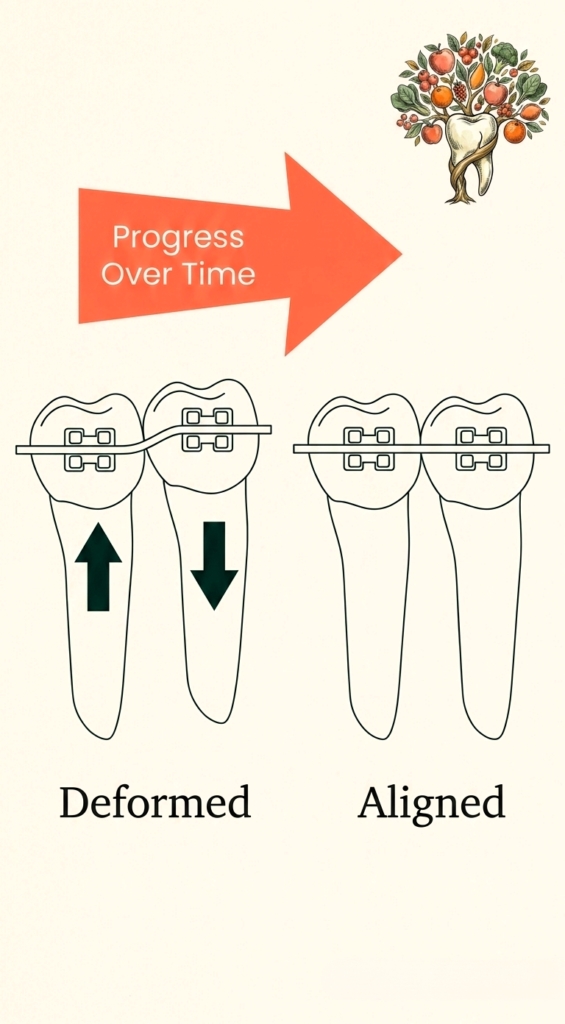
Teeth are not rigidly fixed in bone. They are held in place by a network of fibres and a thin ligament — the periodontal ligament — that sits between the root of the tooth and the jawbone. When a consistent, gentle force is applied to a tooth (via a brace wire or aligner tray), it creates pressure on one side of the ligament and tension on the other.
This triggers bone remodelling: bone cells dissolve on the pressure side and deposit new bone on the tension side. The tooth migrates gradually through the jaw. This process happens in children, teenagers, and adults. The main difference is pace — bone remodelling is slightly faster in younger patients because their metabolism is generally more active, but it is very much possible across all ages.
Who Needs Orthodontic Treatment? It Is Not Always About Aesthetics
Many people assume braces are a cosmetic choice. While improved confidence and appearance are real and valid outcomes, orthodontic treatment is primarily about function and health. Here is who genuinely benefits:
Children (Ages 6–12): Interceptive Orthodontics
Early orthodontic evaluation — often called interceptive or Phase 1 orthodontics — is recommended around age seven. At this stage, the jaws are still growing and highly responsive to guidance. Dentists can identify jaw width problems, crossbites, overbites, or underbites that are far easier to correct now than later.
For example, we treated an eight-year-old named Kabir who had a significant crossbite — his upper jaw was narrower than his lower, causing his teeth to interlock incorrectly. Using a simple, removable palatal expander for eight months, we widened his upper jaw to the correct width. Had we waited until he was 16, the same correction would have required either jaw surgery or prolonged orthodontic treatment. The window matters.
Teenagers (Ages 12–18): The Classic Window
Most permanent teeth have erupted by age 12–13, making this an ideal time for comprehensive orthodontic treatment. The jaws are still growing, making tooth movement relatively efficient. Traditional metal braces, ceramic braces, and clear aligners are all effective options at this stage.
Adults: Any Age, Any Stage
Adults make up a growing proportion of orthodontic patients globally — now estimated at 25–30% of all orthodontic cases. The reasons are varied:
- They did not have access to treatment in childhood
- Teeth have shifted over time — this is extremely common, particularly behind the lower front teeth, where crowding tends to worsen with age
- Previous treatment has relapsed — retainers were not worn consistently, and teeth moved back
- Dental work requires tooth repositioning — before implants, bridges, or veneers, teeth sometimes need to be moved into better positions
- TMJ issues or bite problems causing jaw pain — orthodontic treatment can improve how the upper and lower teeth meet, reducing strain on the jaw joint

Types of Braces: What Are the Options?
Traditional Metal Braces
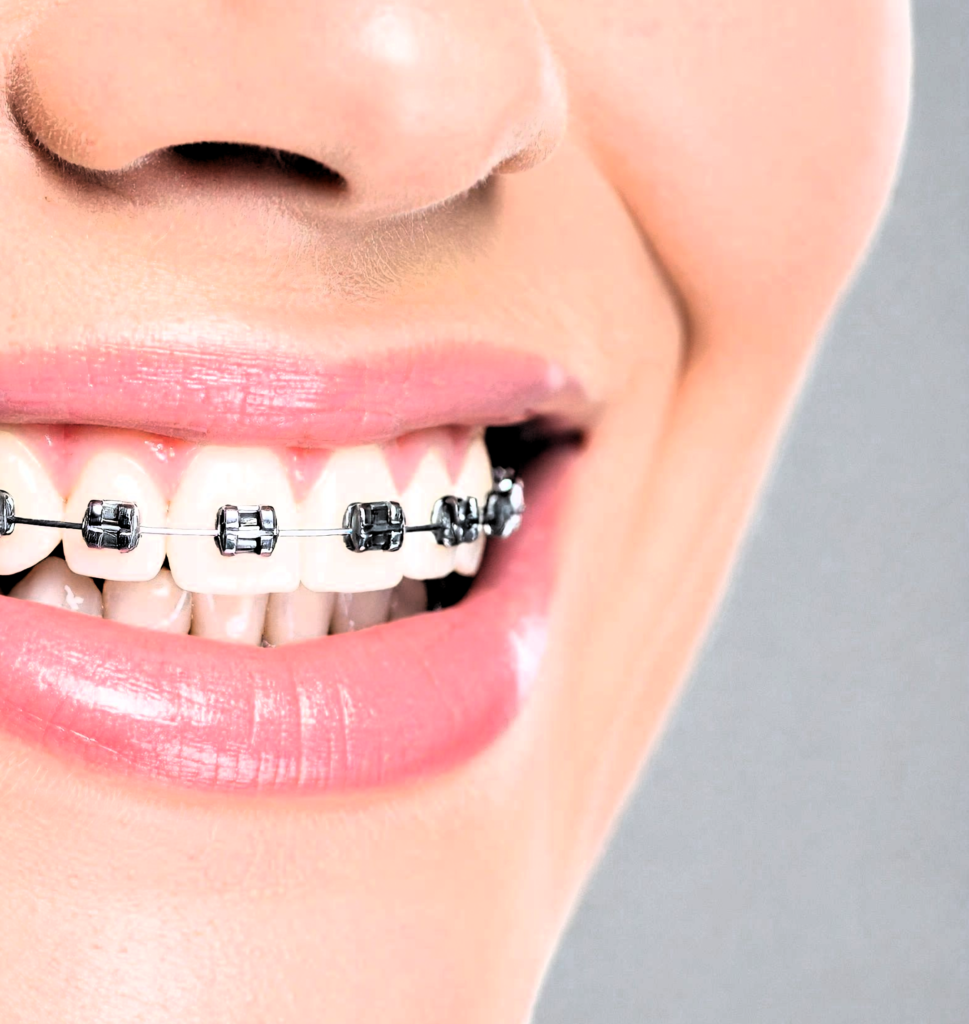
Metal braces consist of brackets bonded to the teeth connected by archwires and elastics. They are the most effective option for complex cases — severe crowding, large bite discrepancies, rotations. Modern metal braces are sleeker and more comfortable than their predecessors. They require no compliance from the patient to work, making them reliable for children and teenagers who might not consistently wear aligners.
Ceramic (Tooth-Coloured) Braces
Ceramic braces work exactly like metal braces but use tooth-coloured or clear brackets that blend with the teeth. They are significantly less visible than metal and are popular with older teenagers and adults who want effectiveness with reduced aesthetic impact.
Clear Aligners (e.g., Invisalign, Toothsi, ClearPath)
Clear aligners are a series of custom-made, removable trays that gradually shift the teeth. They are nearly invisible, removable for eating and brushing, and generally cause less discomfort than fixed braces. They work best for mild to moderate crowding, spacing issues, and many bite corrections.
The critical factor with aligners is compliance — they must be worn 20–22 hours per day to be effective. For motivated adults and older teenagers, they are an excellent option. For younger children or those likely to leave them out, fixed braces are more reliable.
Lingual Braces
Lingual braces are placed on the inside (tongue side) of the teeth, making them completely invisible from the outside. They are highly customised and more expensive, but offer effective treatment with zero visible hardware.
The Treatment Process: What to Expect
Understanding what orthodontic treatment actually involves demystifies the process considerably.
- Consultation and records — X-rays, photographs, and sometimes a 3D scan are taken to assess the teeth, roots, and jaw structure
- Treatment plan — the orthodontist maps out the required movements, estimated duration, and the most appropriate appliance
- Fitting — for braces, brackets are bonded to the teeth in a single appointment. For aligners, a series of trays is fabricated and delivered
- Regular adjustments — for braces, typically every 4–8 weeks. For aligners, tray changes every 1–2 weeks
- Retention — after active treatment, retainers (fixed or removable) hold the teeth in their new positions. This phase is lifelong or the teeth will gradually relapse
How Long Does Treatment Take?
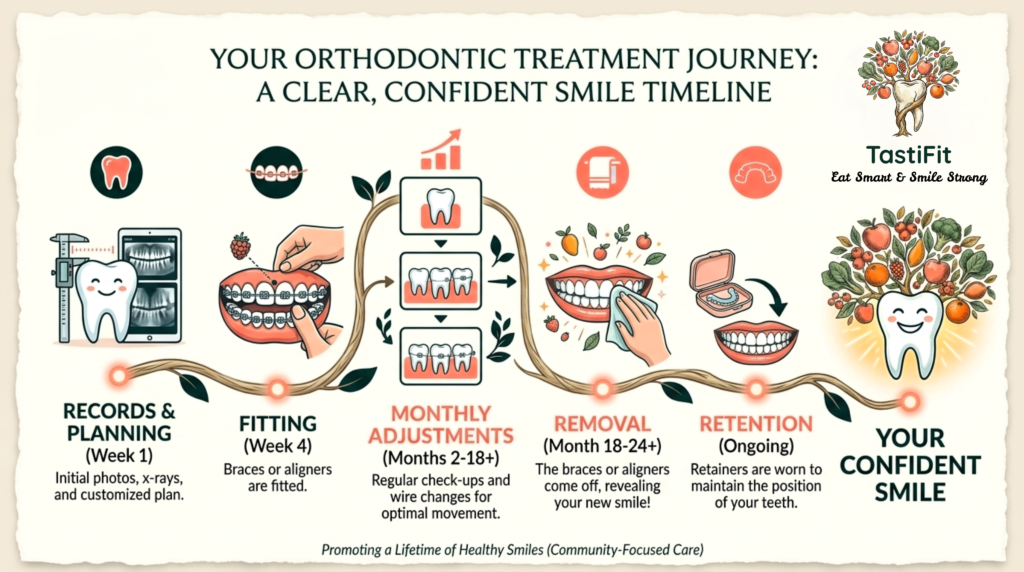
Duration varies enormously based on the severity of the case, the age of the patient, and the type of appliance. As a general guide: mild cases may resolve in 6–12 months; moderate cases in 12–18 months; complex cases in 18–30 months
Adults typically take slightly longer than teenagers for the same complexity of case, because bone remodelling is slower. However, adults also tend to be more compliant with appointments and with wearing retainers — which balances the equation considerably.
Sunita, our 47-year-old architect, completed her aligner treatment in 14 months. Her case was moderate complexity. She found the process far less disruptive to her professional life than she had anticipated — she could remove the aligners for client meetings, presentations, and meals.
Common Myths About Braces — Addressed
- “Braces are only for kids.” — Adults account for nearly 30% of orthodontic patients worldwide.
- “Braces are extremely painful.” — Modern braces cause mild soreness after adjustments for 1–3 days. It is manageable and temporary.
- “My teeth are too old to move.” — Teeth move through bone via the periodontal ligament at any age.
- “Braces will weaken my teeth.” — Done properly, orthodontic treatment does not damage teeth or roots. It may actually reduce the risk of decay by making teeth easier to clean.
- “After braces, my teeth will stay in place forever.” — Only with consistent retainer wear. Without it, relapse is common within 2–5 years.
The Connection Between Straight Teeth and Long-Term Oral Health
Beyond aesthetics, properly aligned teeth are genuinely healthier teeth. Crowded or overlapping teeth are harder to clean — plaque accumulates in the tight contacts where brushing and flossing cannot reach. Over time, this increases the risk of decay, gum disease, and bone loss.
Bite alignment matters too. An incorrect bite — whether an overbite, underbite, crossbite, or open bite — places uneven forces on the jaw joint (temporomandibular joint) and on individual teeth. Chronic bite problems are associated with jaw pain, teeth grinding, and accelerated tooth wear, all of which compound over decades.
When to Consider Orthodontic Evaluation
You do not have to wait for obvious problems to consider an orthodontic consultation. Consider visiting an orthodontist if you notice crowding, spacing between teeth, teeth that do not meet properly when biting, jaw pain or clicking, teeth grinding, or difficulty cleaning between teeth.
Orthodontic treatment is one of the few dental interventions where the outcome — a healthier bite, better hygiene, and increased confidence — tends to be permanent when properly maintained. Age is not a barrier. Willingness to commit to the process is the only real prerequisite.
drbansi@tastifit.com
Nutritionist & Dentist
- April 19, 2026
- 9:47 am
- TastiFit
- Dr. Bansi Parikh