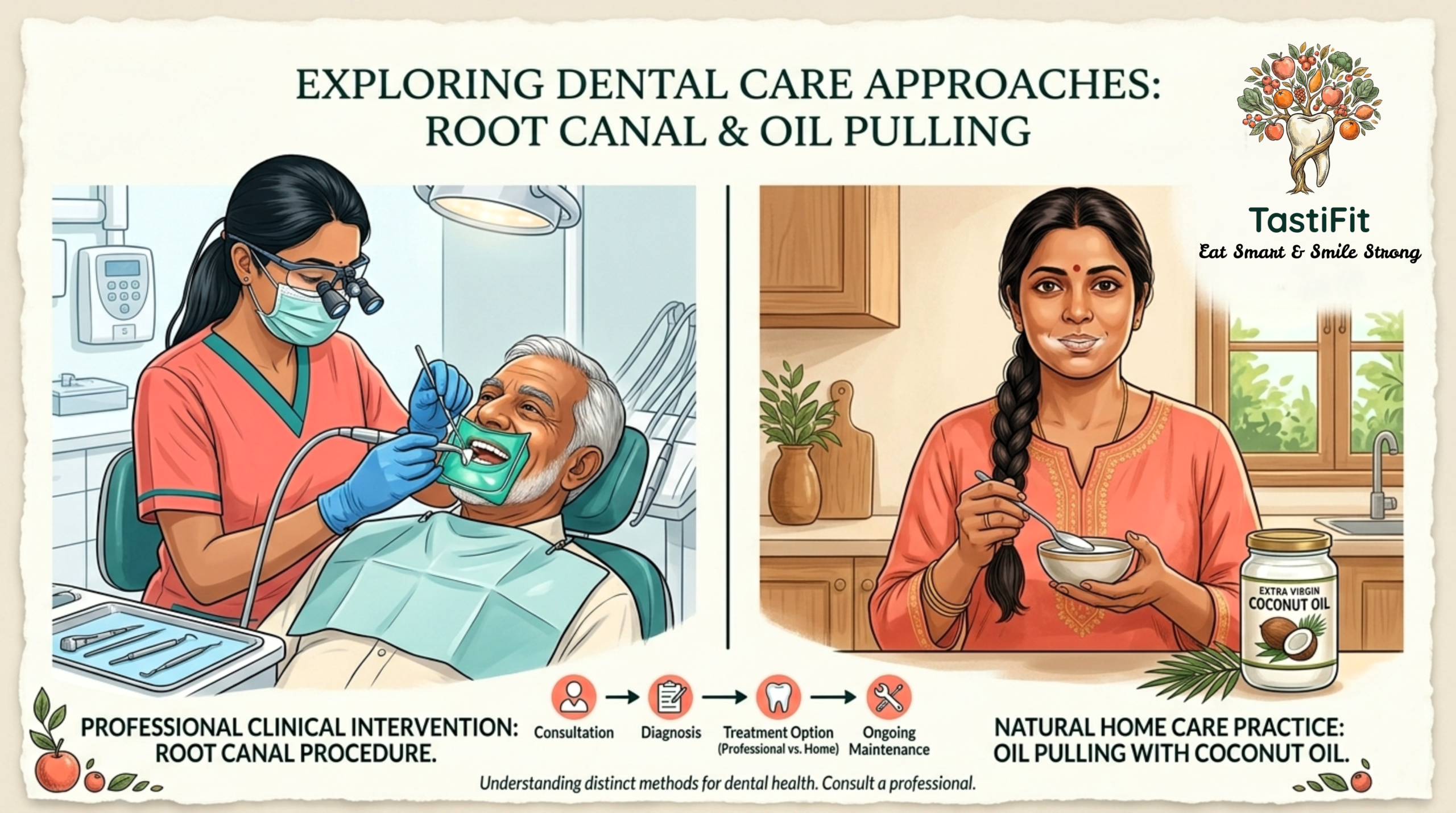
It is a question we have been asked more times than we can count: “Can I just do oil pulling instead of getting a root canal?” The short answer is no. But the longer answer — and the reasons why — are worth understanding, because the persistence of this question reflects something real: a genuine, understandable desire to find a gentler, more natural alternative to dental procedures that carry a reputation for being feared.
Let us talk about both oil pulling and root canals honestly, without dismissing either. Oil pulling has legitimate benefits — just not the ones that will save an infected tooth. And root canals, despite their fearsome reputation, are far more straightforward than most people expect.
Oil pulling is a legitimate oral health practice — but can it replace a root canal? We break down the science behind both, what each can and cannot do, and when professional treatment is essential.
What Is Oil Pulling, and Where Does It Come From?
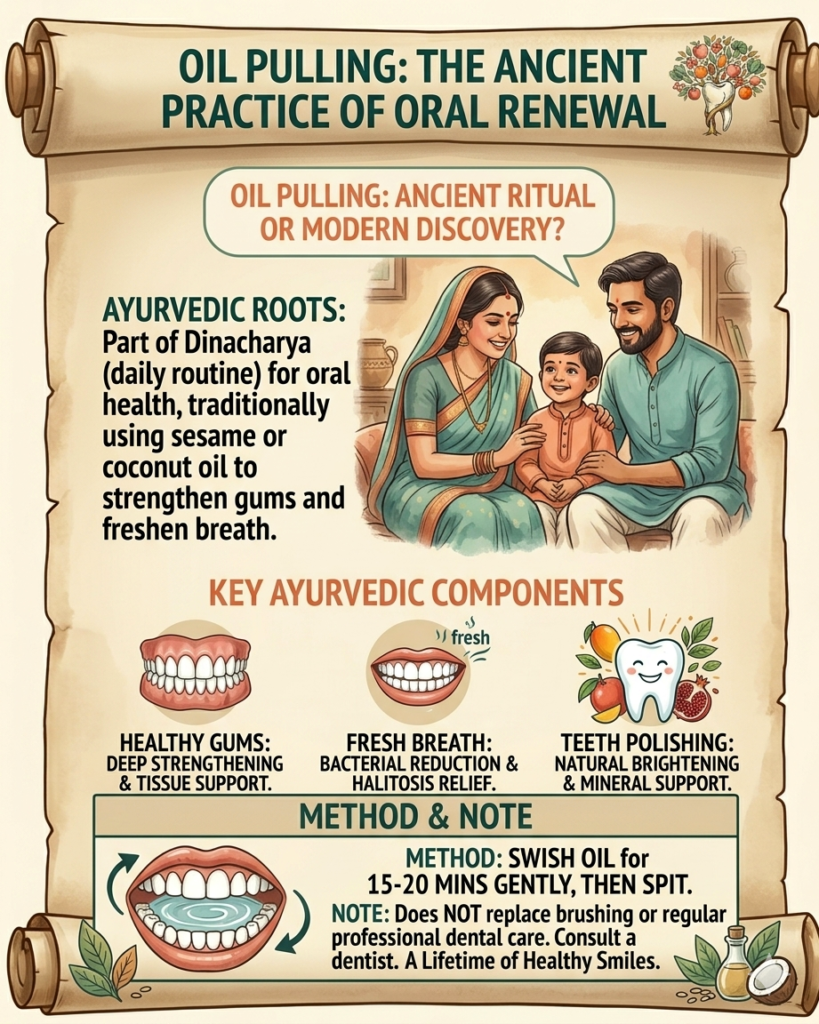
Oil pulling is an ancient Ayurvedic practice — swishing oil (traditionally sesame or coconut oil) around the mouth for 15–20 minutes before spitting it out. References to it appear in classical Ayurvedic texts like the Charaka Samhita, making it thousands of years old.
Its proponents claim it can cure tooth decay, treat gum disease, detoxify the body, and even reverse infections. Some of these claims are supported by research; others are not
What Does the Evidence Actually Say About Oil Pulling?
What it genuinely does:
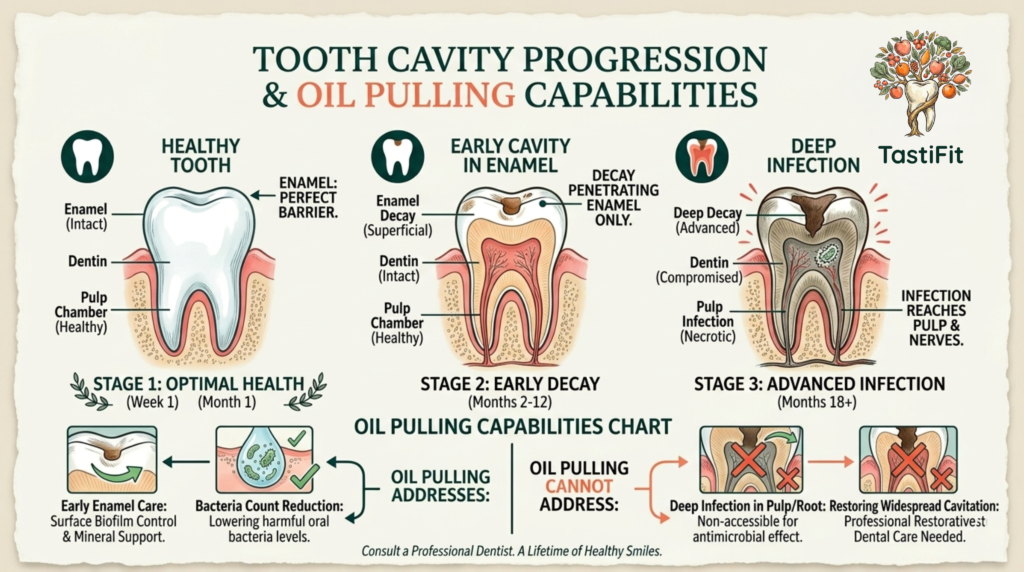
- Reduces certain oral bacteria — studies have shown that oil pulling with coconut or sesame oil can reduce counts of Streptococcus mutans, the primary bacteria associated with tooth decay, and other harmful microorganisms
- Reduces plaque and gingivitis — multiple clinical trials have found oil pulling to be comparable to chlorhexidine mouthwash in reducing gingivitis (gum inflammation) and plaque scores in mild to moderate cases
- Freshens breath — by reducing oral bacteria load, oil pulling can reduce halitosis (bad breath)
- Gentle on enamel — unlike alcohol-based mouthwashes, oil does not disrupt the oral mucosa or contribute to dry mouth
What it does not do:
- It cannot reverse an existing cavity — once enamel has been breached and dentine is involved, no amount of oil pulling, remineralisation, or natural remedy will close the hole. The bacteria are already inside the tooth structure
- It cannot treat a pulp infection — when bacteria have reached the nerve and blood vessel system inside the tooth (the pulp), the infection cannot be resolved by anything applied externally or swished around the mouth
- It cannot replace a root canal — this is the point that matters most, and the one we return to throughout this article
What Is a Root Canal, and Why Is It Recommended?
A root canal (endodontic treatment) is recommended when the pulp of a tooth — the innermost chamber containing nerves and blood vessels — becomes infected or irreversibly inflamed. This typically happens when decay progresses deeply enough to reach the pulp, when a crack in the tooth allows bacteria to enter, or following dental trauma.
Once the pulp is infected, the infection does not resolve on its own — it spreads. The bacteria travel down through the root canals toward the tip of the root, where they can form an abscess: a pocket of pus at the tip of the root. From there, the infection can spread to surrounding bone, adjacent teeth, and — in serious cases — to the jaw and neck. This is not hypothetical; dental infections that go untreated can become life-threatening emergencies.
What Happens During a Root Canal?
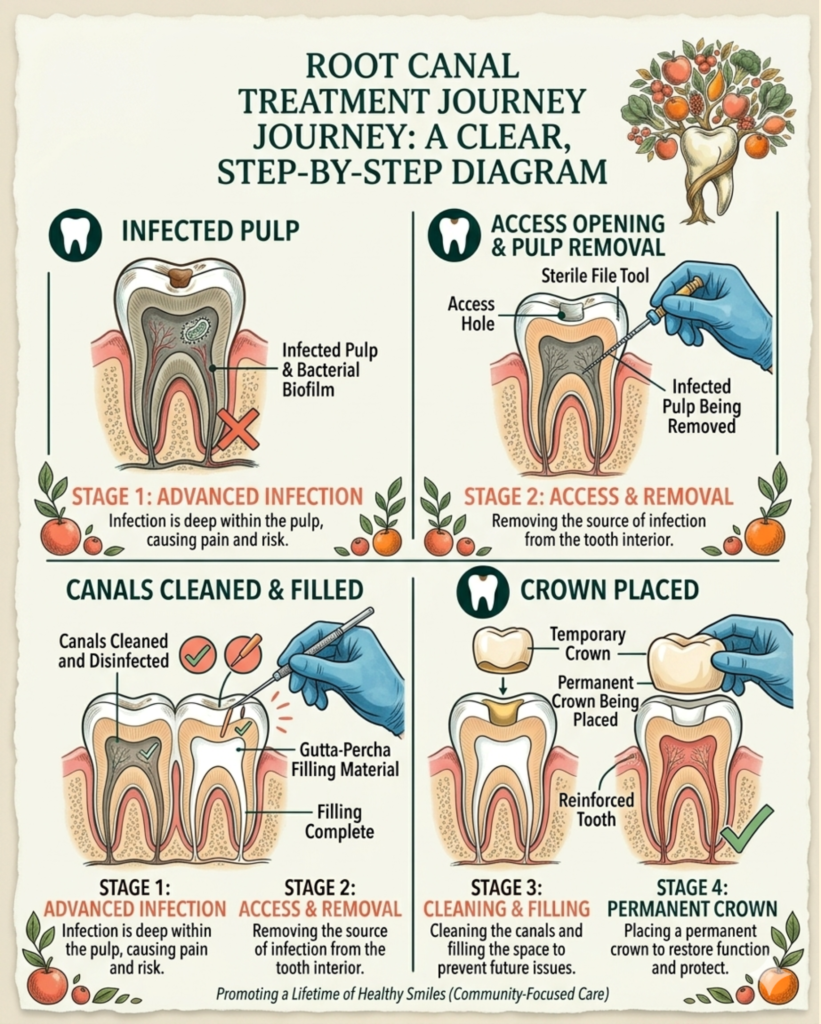
The procedure is commonly feared, but largely undeserved in that reputation. Here is what actually happens:
- Local anaesthesia is administered — the procedure is performed with the area completely numb. The most common patient report? “I barely felt anything.”
- The infected pulp is removed — the dentist or endodontist accesses the pulp chamber, removes the infected tissue, and cleans and disinfects the canal system
- The canals are shaped and sealed — the cleaned canals are filled with a biocompatible material (gutta-percha) and sealed to prevent reinfection
- A crown is typically placed — the tooth, now devoid of its internal nerve supply, becomes more brittle over time. A crown protects it from fracture and restores function
The procedure usually takes 1–2 appointments. Discomfort afterward is typically mild and managed with over-the-counter painkillers. Most patients return to normal activities the same day or the day after. The pain from the infection before the root canal is invariably far worse than the procedure itself.
One of our patients, a 38-year-old teacher named Vivek, had been managing tooth pain for three months by rinsing with salt water and doing oil pulling twice a day. He was convinced the pain was “getting better” — it was actually waxing and waning as the infection’s activity fluctuated. When he finally came in, we found a significant periapical abscess. After his root canal, he told us: “I honestly cannot believe I was afraid of that. The three months of toothache were a hundred times worse.”
Can Oil Pulling Prevent the Need for a Root Canal?
This is a nuanced but important question. Oil pulling, used consistently as part of a broader oral hygiene routine, can reduce the overall bacterial load in the mouth — which in turn reduces the risk of tooth decay and the gum disease that can worsen dental problems. In this indirect sense, yes, good prevention (including practices like oil pulling) reduces the lifetime likelihood of needing complex dental treatment.
But this is the same as saying eating well and exercising reduces the likelihood of needing surgery — it is true, and it matters, but it does not replace surgery when surgery is what is needed.
By the time someone is asking “should I oil pull instead of getting a root canal,” the window for prevention has already closed. That tooth needs treatment.
Why People Delay Root Canals — and the Cost of Delay
Fear is the most common reason. Followed by cost. And sometimes, a period of temporary relief — where the pain subsides — convinces people that the problem has resolved. It has not. The infection is progressing silently.
Delaying root canal treatment leads to:
- Abscess formation — a painful, potentially dangerous accumulation of pus at the root tip
- Bone loss — the infection destroys the jawbone around the root, which may eventually compromise adjacent teeth
- Tooth loss — if the infection destroys too much supporting structure, extraction becomes the only option
- Systemic spread — dental infections, in rare but documented cases, have spread to the neck, chest, and brain. Ludwig’s angina and deep space infections of the jaw are dental emergency-driven conditions
- Higher cost — the longer treatment is delayed, the more complex and expensive the required intervention becomes
The Middle Ground: Using Both Wisely
Oil pulling is not your enemy, and root canals are not your punishment. They serve entirely different purposes.
Oil pulling is a preventive and supportive oral health practice — best used daily as a complement to brushing, flossing, and regular dental check-ups. It can meaningfully reduce your oral bacterial load and early gum inflammation. Use it. It costs almost nothing and the evidence supports it for these purposes.
Root canal treatment is a clinical intervention for an established, progressive infection — one that cannot resolve without professional treatment. When this is what your tooth needs, no amount of natural remedies will adequately substitute.
The wisest approach is to invest in prevention consistently — so you need intervention as rarely as possible. And when intervention is needed, to pursue it without delay, rather than hoping the problem resolves on its own.
Final Thought
Dentistry is not trying to replace your natural remedies. The goal of every dentist is to keep as much of your natural tooth structure — and as many of your natural teeth — as possible. Root canals save teeth that would otherwise be lost. Oil pulling keeps the mouth healthier so fewer teeth need saving.
They are not rivals. They are on the same team — just playing at very different positions.
drbansi@tastifit.com
Nutritionist & Dentist
- April 19, 2026
- 9:52 am
- TastiFit
- Dr. Bansi Parikh